Christmas Traditions in Germany
Advent customs, Saint Nicholas Day and Christmas Eve
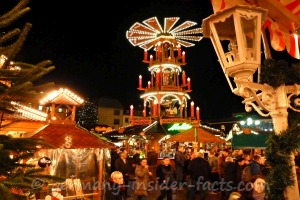
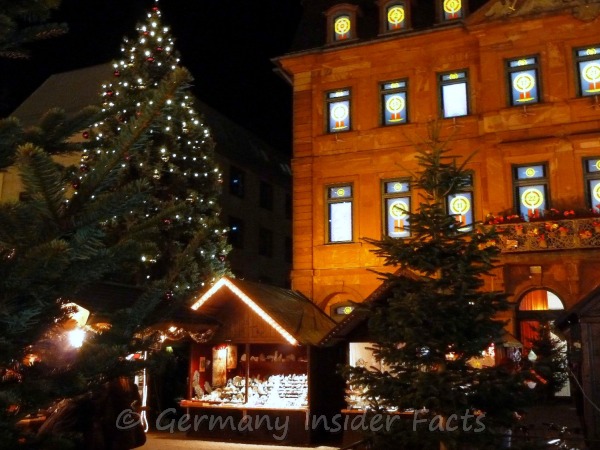
Favourite Christmas traditions in Germany include a visit to one of the
various Christmas markets (Weihnachtsmarkt), baking yummy cookies, and
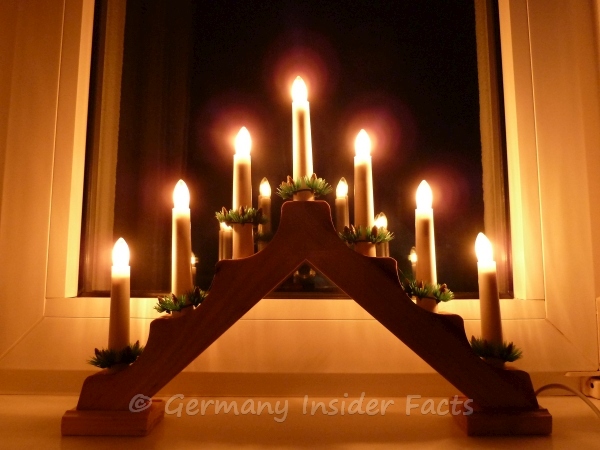
decorating the home with candle arches, twigs and wooden pyramids.
But there are many more traditional customs that make Advent and Christmas a very special time of the year.
Although Christmas (Weihnachten) has become very commercialised since I
was a child 60 years ago, the magic of Christmas is hard to deny if you
grew up with all the wonderful traditions. Weihnachten has still a deep
meaning for us Germans and especially for families with children. As
soon as the kids open the first window on their Adventskalender, they
are held in joyful anticipation.
What you find on this page - Table of Content (Toc)
Christmas Traditions in Germany - Advent Customs
For the Western Christian Churches Advent is the time to wait and
prepare for Jesus' birth at Christmas. The first Advent Sunday is also
the beginning of the Western Christian Year. Advent in the Eastern and
Orthodox Churches is slightly longer, and begins already on 15th
November.
 Lichterbogen - Simple Candle Arch
The first Advent Sunday is the fourth Sunday before Christmas Day (25th December). An Adventskranz
(advent wreath), usually made of fir twigs, decorated with small stars,
ribbons, fir cones and four candles, can be found in nearly every home.
In the first week only one candle is lit, the second follows on the
second Advent Sunday, and so on.
Advent is the time when houses smell of freshly baked cookies,
Stollen and candles. The kids do handicraft Christmas decorations or
small presents for the parents.
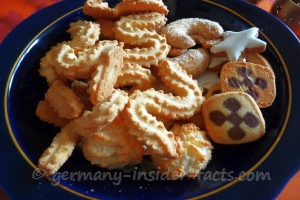
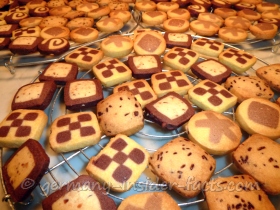
Of course the kids love to help with baking traditional German Christmas cookies, and pinch a few of the fresh goodies.
It is also common that children write a letter to the Christkind or the Weihnachtsmann with their wishes for the gifts they hope to see under the Christmas tree.


An Adventskalender (advent calendar) also belongs to German
Christmas traditions. In former days it was a simple painted cardboard
with 24 windows, or doors, to open. Behind each window was a Christmas
themed picture.
These days, Advent calendars often contain a piece of chocolate, or a
small toy, when you open the window. It is also very common to create an
individual advent calendar with 24 small packets or stockings
containing a little gift.
Childhood memories - Advent Poem
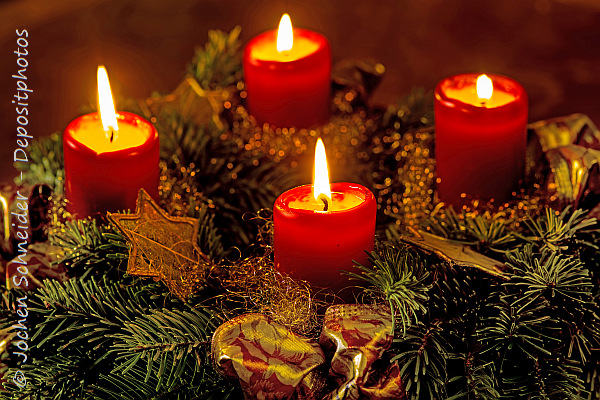 Adventskranz - Christmas wreath
When I was a child, I loved the Adventstunde, it was one of my favourite Christmas traditions in Germany.
The family sat around the Adventskranz singing Christmas carols and
nibbling home made cookies. We kids were always very excited
and dreamt about the presents the Christkind (Christ child) hopefully would bring on Christmas Eve (Heiligabend).
"Advent, Advent ...ein Lichtlein brennt
erst eins, dann zwei, dann drei, dann vier
dann steht das Christkind vor der Tür."
This is a famous Christmas poem in Germany. Roughly translated it says:
Advent, Advent, a light is burning, first one, then two, then three then
four, then the Christkind stands at the door.
Another old Advent custom is to cut a cherry branch and put it in vase inside the home on December 4th (St. Barbara's Day). The Barbarazweig will usually bloom at Christmas and brings luck for the following year, and a scent of spring in the dark season.
German Christmas Traditions - Saint Nicholas Day
Saint Nicholas (Nikolaus), Santa Claus (Weihnachtsmann) and the Christ child (Christkind) ... they all bring gifts to children (and adults), either on Nikolaustag (6th December) or on Heiligabend (24th December).
Saint Nicholas of Myra (today Turkey) was a bishop in the 4th
century. Very little is known about the historical Saint Nicholas.
However, lots of legends and folklore surround the bishop, who is the
saint patron of Russia, Croatia, Serbia, children and sailors. He was
known as a generous man, a secret gift giver, who put coins in shoes of
those who were in need, and he had a great fondness for children.
No surprise, he became the model of Santa Claus.
Before the Reformation, Saint Nicholas Day was the day children
received their Christmas gifts. Reformer Martin Luther didn't approve
the veneration of saints like Saint Nicholas. He "invented" the Christ child, a spirit-like figure with blonde hair and wings like an
angel.
It took about 200 years until the Christ child was adopted by Catholic
families in southern Germany and Austria. At the same time the
Christ child was more and more replaced by the Weihnachtsmann (Father Christmas) in the Protestant regions of Germany.
My memories from childhood - Nikolaus
Anyway, back to St. Nikolaus who often visited children at home. We kids
were always a little worried what he would tell us from his golden
book. Mysteriously, Nikolaus had listed our bad behaviour throughout the
year in this book. How could he know?
After we promised to be good next year, we had to recite a Christmas poem and jump over the rute (rod, usually a small tree branch) to receive a slight smack on the back with the rod.
Occasionally, Nikolaus was accompanied by his helping hand Knecht Ruprecht, who would take over the job of giving us a smack.
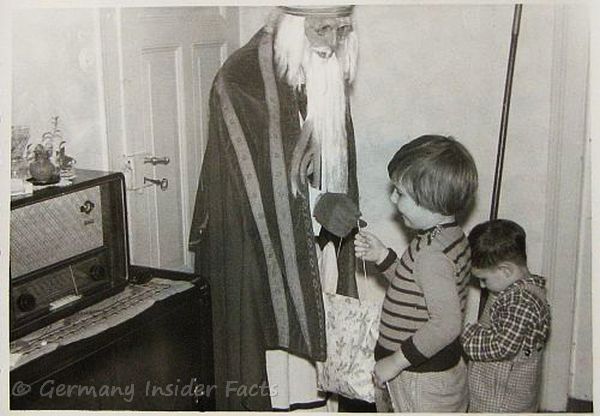 Saint Nicholas wearing a bishop's robe visiting children at home in 1960
That's me and my brother in the picture, and this was towards the end of Saint Nicholas' visit. We got a bag with sweets, nuts and fruits, at last. My brother still looks a bit guilty, but he got his bag as well :).
In Germany, Nikolaus was originally wearing a bishop's robe and he was a different figure than the Weihnachtsmann (literally translated Christmas man). However, these days Nikolaus and Santa Claus seem to be mingled.
How Christmas in Germany is celebrated these days
Finally, Christmas Eve (Heilig Abend), the day that has held the family in eagerly anticipation for weeks, has arrived.
When I was a child, it was very common that the kids didn't see the Christmas tree (Weihnachtsbaum) before Heilig Abend.
This has changed slightly. Some families decorate the tree together
with the kids a day (or even longer) before the holidays to reduce the stress from the
working parents.
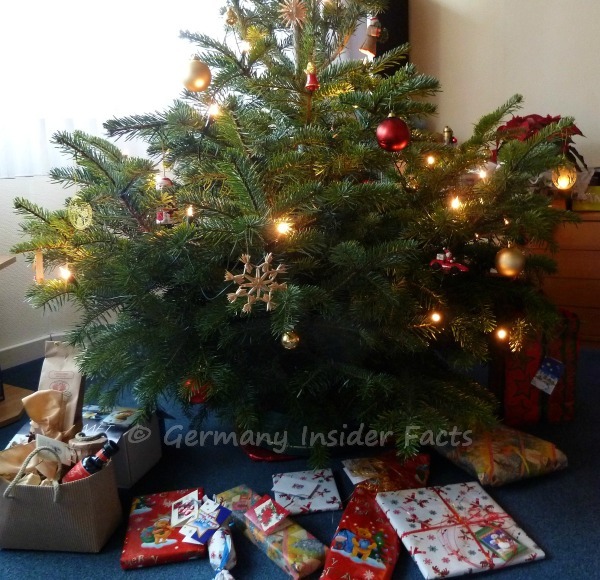 Gifts in front of a Weihnachtsbaum
Although most people don't have to work (except those working at stores
and public services), shops are usually open on Heiligabend (24th) until
the early afternoon. Then public life in Germany falls quiet. It is a
widespread custom to visit the graves of family members in the
afternoon, before the Christmas celebrations begin.
When it gets dark, families gather around the Christmas tree,
singing Christmas carols (Weihnachtslieder) and share their joy with the
gifts that everyone unwraps. Finally, they join for a simple meal around the
nicely decorated table.
Later on Christmas Eve many people go to the Midnight Mass or Christmette.
Christmas Day is called 1. Weihnachtsfeiertag and Boxing Day is
the 2. Weihnachtsfeiertag. These days are reserved to visit, or invite,
grandparents and other family members for a festive meal, or
just to stay at home and relax after all the festivities.
Both days are public holidays and shops are closed.
I hope you enjoyed to read about the Christmas traditions in Germany. Frohe Weihnachten.
Now you sure are in festive mood?
Discover more about how we celebrate Weihnachten!

- Home ›
- German Christmas Traditions