German Currency
Where to exchange foreign currencies?
Credit card or cash while travelling in Germany?
The German currency is the Euro. Actually, the Euro is not "German money", but it is the currency we use in this country, and in other countries of the Euro zone.
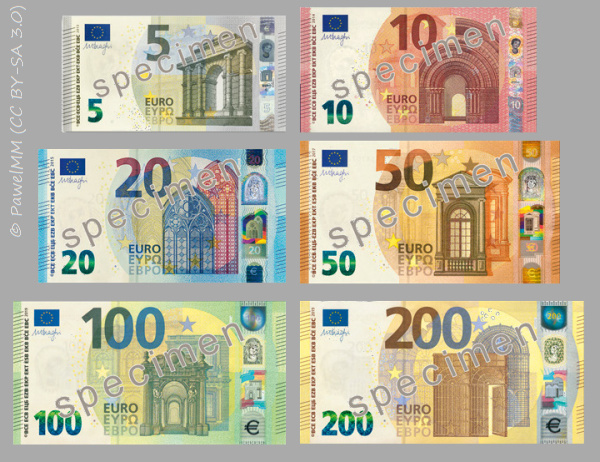
The Euro replaced the German Mark (Deutsche Mark) and it is the official currency of the European Union.
If you visit Germany from a country within the euro zone, you are a happy traveller!
No need to worry about the best exchange rates before you leave home. While you travel in Germany, you don't need to calculate prices into another currency.
Isn't it very handy to travel in a foreign country with the currency you are used to?
Facts about the Euro
The Euro was introduced as cash currency in Germany on 1st January 2002,
although it was used for cashless transactions by banks and stock
markets in the euro zone since 1999. An Euro starter kit, to get people
used to the new German currency, was released on 17th December 2001.
Not all Germans were happy about the introduction of the Euro. Many
fellow Germans wanted to keep the strong Deutsche Mark. Others were
angry that we didn't have a referendum like other European countries. In
Germany, the introduction of the Euro was the sole decision of our
political leaders.
Now we all got used to the Euro, although you will still hear
voices who say that expenses for daily life have become more expensive.
Nineteen states in Europe currently use the Euro. These states are
Austria, Belgium, Cyprus, Estonia, Finland, France, Germany, Greece,
Ireland, Italy, Latvia, Lithuania, Luxembourg, Malta, the Netherlands,
Portugal, Slovakia, Slovenia and Spain.
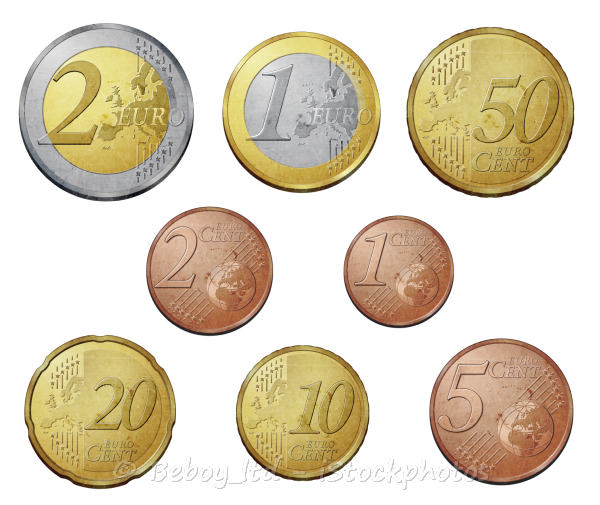 The common side of the Euro coins
Euro banknotes are issued in €500, €200, €100, €50, €20, €10, €5 notes.
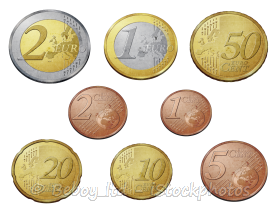
Denominations of Euro coins are €2, €1, 50c, 20c, 10c, 5c, 2c, and 1c.
The Euro notes, front and back side, are the same in all countries.There is an identification code telling where the note was issued/printed.
Since early 2019 the 500 Euro note is not issued any more. Of course the notes are still valid. I admit, I never had a 500 € note in my hands.
All Euro coins have a common side showing their value, while the national side shows an image chosen by each country.
Euro coins from any member state are valid in all states throughout the Euro zone.
How to pay in Germany?
There's no doubt, you need money when you travel around Germany! :)
For visitors from outside the Euro zone the below online currency
converter tool is handy to check how many Euro you get for your local
currency.
Credit cards are widely accepted, although paying with credit cards is
not as common as in the USA, for example. Mastercard & Visa
dominate. American Express & Diners Club are accepted in some stores
and of course you can use them with the Geldautomat. Check shop windows
and entrance doors for credit card logos to see which cards you can use
inside.
Supermarkets, department stores and restaurants, especially in smaller
towns outside tourist regions, might only accept a German bank card, or
cash. You will definitely have to pay cash at many locations in Germany.
German Currency - Where to get cash
You can get money from a Geldautomat (ATM - automated teller
machine) at major train stations, airports, large shopping centres and
in and outside banks.
Within the eurozone charges for ATM withdrawals and credit card payments
are domestic payments and you get domestic fees charged.
For visitors from the US, Canada, Australia and any other country outside the euro zone it is a different story.
You can buy currency online and spend hours searching for the best exchange rates. Does it make sense? I don't know.
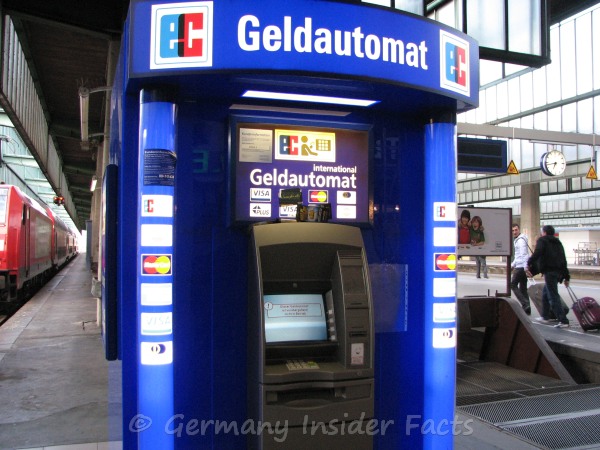 Automated Teller Machine at a train station
I did some research, and discovered that many experienced world travellers do exactly what I do when I go abroad.
Accept that you have to pay transaction fees when you
buy foreign currency. Don't fret over the best exchange rates, instead
use time time to plan your holidays.
Use a mix of payment methods while you travel in Germany.
Talk with your bank at home to check what they charge
if you withdraw foreign currency with your credit card or your bank
card. Your bank card should have a Visa, Mastercard or EuroCard logo to
work with ATMs in Germany and Europe.
Don't forget to memorise the PIN for these cards.
Consider buying some traveller checks issued in Euro to get cash in Germany. You might also be able to use them to pay in shops and hotels.
Use your credit card to pay for accommodation, car rentals, fuel and purchases over 100?
Exchange money in Germany/Europe, not at home. Banks usually give you better exchange rates than commercial foreign exchange counters at airports and major railway stations.
If you cash traveller checks or withdraw money from an ATM you might have to pay a fee per transaction. So don't withdraw a small amount daily, better get the money you need for the next few days.
Bring a small amount of Euro from home. So you don't need to panic when you arrive in Germany outside working hours of banks.
Discover more interesting facts about Germany



- Home ›
- General Facts ›
- German money
Favourite Articles







Private guided tours
Discover Germany at your own pace. Work out your very own itinerary with your tour guide. Know that you don't have to worry about hotels and the best places to eat. Everything is cared for. You just need to enjoy Germany.
 Click here to learn more about your private tour